 Code of Conduct
 Ethical Mgmt
 Speak-up Culture
 Latin America
 Asia Pacific
 FX Global Code
 Financial Services
 North America
 Europe
 Middle East
 MSBs
MSBs FinTech
 Insurance
 Investing
 Casinos
 Retail Banks
 Manufacturing
 U.S. National
 Canada
 California
 New York
 Illinois
 Connecticut
 Maine
Maine Delaware
 Retail
 Warehouse
 Healthcare
 Animated
 Billing & Revenue
 IT & Admins
 Leadership
 Ontario
 British Columbia
 UK Induction
 Australia & NZ
 Workplace Violence Prevention
 Canada
 Italy
Italy Active Shooter
 AI & Workplace
 Corporate Ethics
 Whistleblower
 Gvmt Contracting
 Export Controls

Last updated: September 2026
Switching your hotline and case management used to be a real commitment. Budget, internal alignment, and someone who owns the migration. That's the math NAVEX has been counting on for thirty years.
We went back through 1,560 conversations with compliance, ethics, and HR leaders at roughly 900 companies, most of them between 1,000 and 10,000 employees. When teams leave NAVEX, the same seven reasons come back.
1. Case management that holds up a year later
What we hear. NAVEX's case management takes the report and stops. There's no investigation workflow behind it, so admins dump the data into Excel to filter it, and the board deck gets rebuilt by hand every quarter. One compliance manager called it "antiquated." Another was blunter than we'd put in print.
How Ethena's different. Structured statuses, case due dates with overdue views, a days-open metric, and per-category required fields that gate closure. Custom and dependent fields, case linking, and a full audit trail on every case. Case management here covers the whole investigation, from the first report to the closed file. When your GC or a regulator asks about a case a year later, the documentation is in the case.
2. Admin experience
What we hear. "It becomes a nightmare for people to manage." Teams describe filing a support ticket to pull basic reporting data, and waiting on a services quote to add a field or translate a page.
How Ethena's different. One login covers training, your hotline, case management, policies, and disclosures. Admins change form fields, categories, branding, FAQs, and translations themselves, instantly, at no cost. Admin seats are unlimited, so your HR partners, investigators, and legal team all get access without a conversation about licenses.
3. AI that does the first pass
What we hear. This is the gap prospects name most often. NAVEX's dashboards are static and its agentic product hasn't shipped, so the triage work still lands on a person.
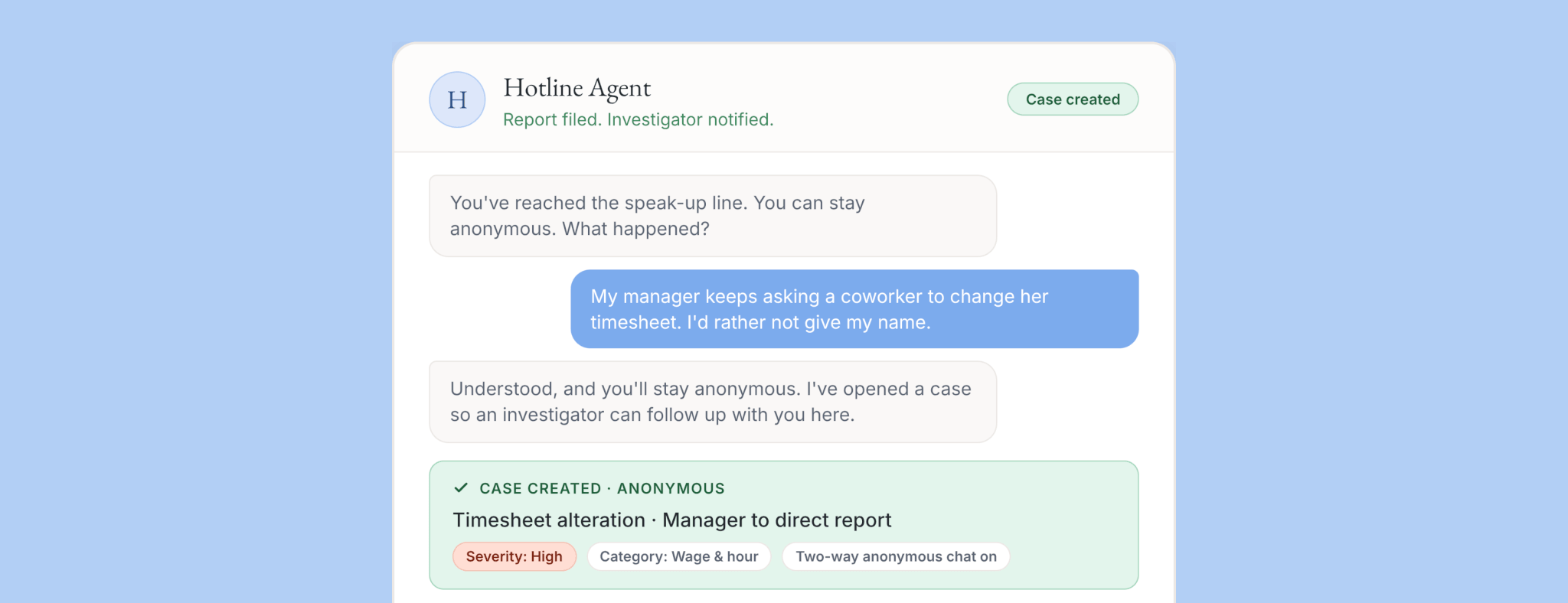
How Ethena's different. We'll name exactly what the AI does. Summaries stay current as a case evolves. Reports categorize themselves. AI case import turns a CSV, an email, or a screenshot into structured cases. Translations go live across intake and content instantly. AI call takers answer your phone line in 20+ languages with no hold time and write the case straight into the system.
Triage and summaries are the machine's job. Substantiation stays the investigator's.
Not sure what to look for when you're evaluating platforms? Start here.
4. Reporting you can take to the board
What we hear. Teams measure volume, substantiation rate, and anonymity rate, then rebuild the same report by hand every quarter because the dashboard can't answer the follow-up question.
How Ethena's different. Ask a question in a sentence and get charts and a board-ready report. Ethena is the only platform where your hotline, case management, training, policies, and disclosures run together, so the analytics read across all of them. We can show you that the business unit generating the most conduct reports is also the one with the lowest training completion, then build the remediation training for that team with the Training Agent.
5. Pricing predictability
What we hear. "They're really expensive. You want another one, it's as much as the first two cost." Translations, extra fields, SCORM, integrations, and admin seats each arrive as their own line item. The renewal terms surface late, and the cancellation window is easy to miss on purpose.
How Ethena's different. Ethena's pricing is straightforward. One price, published as a rate card. No per-seat licensing, no change fees, no charge for translations or case import, and no auto-renewal trap. Teams coming off NAVEX pay meaningfully less and stop budgeting for add-ons entirely.
6. Customer support
What we hear. "The customer service is extremely rigid, unfriendly, and unhelpful." One team logged "over a dozen calls and even more emails" on a single issue. Rep turnover is frequent and QBRs aren't part of the relationship.
How Ethena's different. A dedicated customer success manager from day one, an implementation lead who owns your go-live, and answers in hours. Here's what that looks like in practice.
7. The switch itself
What we hear. Two things keep teams on a system they can't stand. Decades of case history live inside it, and the migration comes back quoted as a services project. On top of that, NAVEX contracts run long, sometimes five years, with a cancellation window that's easy to miss.
How Ethena's different. AI case import brings your history over at no cost, so trend analysis works on day one and you go live in days.
And if you're locked into a contract you've outgrown, we'll buy it out. You don't pay us a dollar until your existing deal ends, and you can implement the day you sign. We'd rather win the account than wait three years for it.
96% of our customers renew year after year.