 Code of Conduct
 Ethical Mgmt
 Speak-up Culture
 Latin America
 Asia Pacific
 FX Global Code
 Financial Services
 North America
 Europe
 Middle East
 MSBs
MSBs FinTech
 Insurance
 Investing
 Casinos
 Retail Banks
 Manufacturing
 U.S. National
 Canada
 California
 New York
 Illinois
 Connecticut
 Maine
Maine Delaware
 Retail
 Warehouse
 Healthcare
 Animated
 Billing & Revenue
 IT & Admins
 Leadership
 Ontario
 British Columbia
 UK Induction
 Australia & NZ
 Workplace Violence Prevention
 Canada
 Italy
Italy Active Shooter
 AI & Workplace
 Corporate Ethics
 Whistleblower
 Gvmt Contracting
 Export Controls

Last updated: September 2026
Are you still evaluating compliance training platforms like you did 5 years ago? Course catalog, completion reporting, HRIS integration, done.
That checklist misses the thing that now separates these six vendors: whether the AI reaches the product you're actually buying, or stops at the press release.
Here's what's on each platform today, what customers say about it, and the five questions worth asking before you sign anything.
What to look for in a training platform in 2026
Five questions. Score each vendor honestly, and be strict: a roadmap slide isn't a yes, and neither is a feature your vendor will quote you for.
- Is the AI inside the product you're buying? Plenty of vendors announce AI. Fewer put it in the training product. Open the vendor's own AI feature page and check whether training is on the list. If the AI lives in analytics and the hotline but not in the thing you're licensing, you're buying a press release.
- Does the platform reinvent itself, and does that reinvention give you time back? Look at the last 12 months of release notes. Count how many shipped features removed work from your plate rather than adding a dashboard to check. A vendor that ships a new report is not the same as a vendor that ships you a Friday afternoon.
- Is training and speaking up under one roof, and do they talk to each other? A harassment report should be able to trigger the training that addresses it. If your hotline lives with one vendor and your training with another, that connection is a person, and that person is you.
- Will the content hold up in front of your legal team and your employees? Two different tests. State-specific harassment requirements change, and so does what people will actually sit through. Ask who writes the content and who keeps it current.
- Can you get a straight answer on price and support? How long it takes to get a number is a preview of how long it'll take to get help.
1. Ethena
Best for: compliance and People teams who want training and their ethics hotline running on one AI system, with a person approving every judgment call.
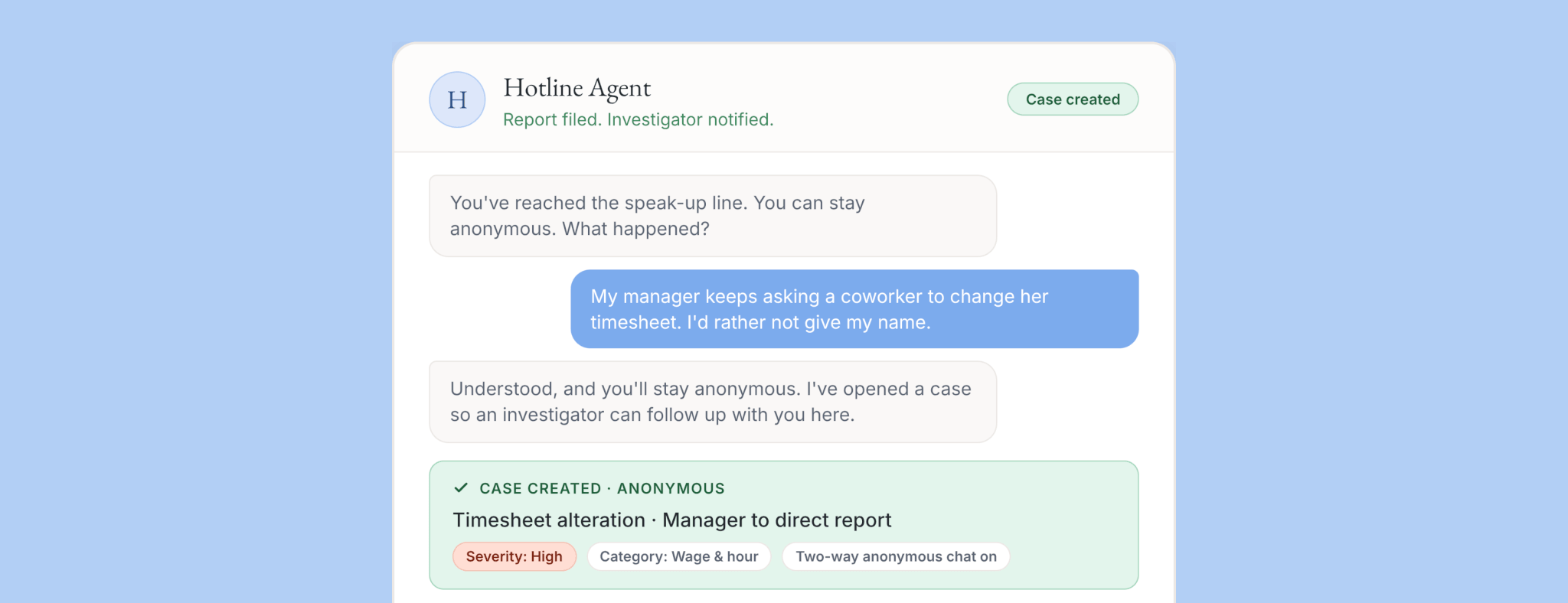
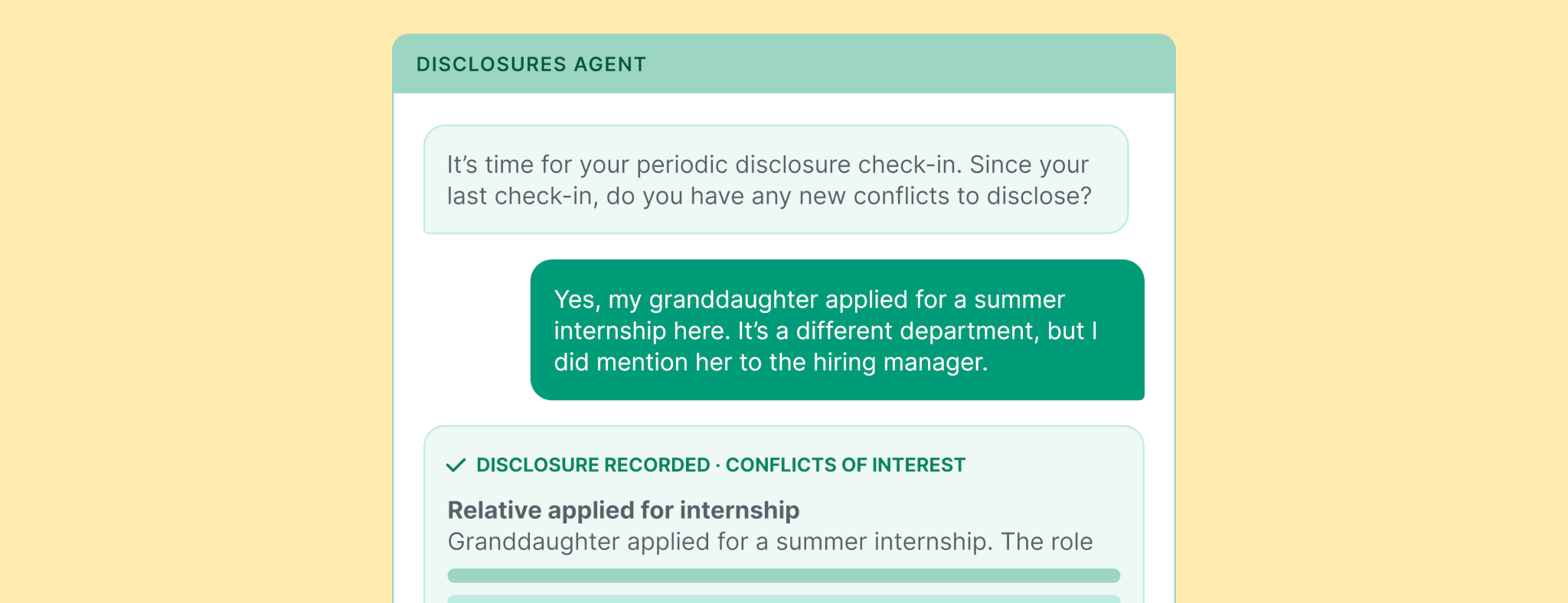
Ethena is a platform of AI compliance agents. Four of them: the Training Agent, the Disclosure Agent, the Policy Agent, and the Third-Party Risk Agent. The Ethics Hotline and Case Management product lives inside the Disclosure Agent, which is why the two halves of this list's biggest gap are one product here.
The pros:
- Training calibrated to your real risk: The Training Agent pulls from your actual disclosure, case, and policy data to decide who needs what. Not because it's February. Because your risk data says so.
- Reports and training on the same system: A harassment report can trigger a targeted refresher from the Training Agent, or a draft policy fix from the Policy Agent. You get one summary and one approval.
- Compliance in the loop: Agents draft, flag, and suggest. You approve, launch, and decide. Nothing ships without your sign-off.
- Content people finish: 200+ courses with a 93% approval rating from 5M+ learner ratings, and a 60% average reduction in seat time. 96% of customers renew year after year.
- Customization measured in hours: Upload a PDF and the Training Agent drafts the course. Darryl Cyphers Jr., Senior Director of Legal Compliance at Klaviyo, put it this way: "I needed to train 500 people on side agreements in two weeks. Ethena made it happen. Custom content, quick turnaround, no drama. When I need something, they're there. No other vendor has shown up like that."
The cons:
- Not a full talent suite. If you need learning, recruiting, performance, and succession in one system, this isn't that. Cornerstone is.
- Not a security awareness platform. There's a phishing simulator, and it isn't the depth a security team running continuous social engineering programs will want.
- Newer than the incumbents. Founded in 2019, with 2,000+ compliance teams on the platform. If your procurement process rewards a 30 year logo over a current product, that's a real internal conversation.
2. Traliant
Best for: US employers with multi-state harassment obligations who want modern content and don't need the hotline in the same place.
Traliant has become the most common alternative on a compliance training shortlist. PSG took a majority investment in January 2021, and the company has since rolled up Clear Law Institute and Kantola. Its cinematic Code of Conduct series, The Code, launched in May 2025 and set a real production bar.
The pros:
- Content people don't dread: Production values are genuinely strong, and the multi-state harassment coverage is current.
- Built for the US mid-market: The regulatory coverage maps to the obligations most US employers actually carry.
The cons:
- No hotline of its own: The Case IQ partnership announced in April 2026 gives customers preferred pricing on someone else's platform. That's two vendors, two contracts, and two places your data lives.
- Roll-up seams: Clear Law Institute and Kantola came in through acquisition, and a catalog assembled that way takes time to feel like one catalog.
3. Emtrain
Best for: teams who want culture analytics layered on top of compliance training.
Emtrain remains independent and venture-backed, with no disclosed funding round since 2020. Its differentiator is Emtrain Intelligence, which reads workplace culture and risk signals off training responses. In November 2025 it partnered with Udemy to put its compliance content in front of Udemy Business customers.
The pros:
- Short lessons that land: Three to five minute microlessons, and reviewers on G2 (4.6 out of 5 across 51 reviews, most from 2026) consistently name engagement as the reason they stay.
- A real AI feature, honestly scoped: AuthorAI helps build and edit courses on top of expert-written content. It does one job and doesn't pretend to do more.
The cons:
- Customization limits: Reviewers cite restricted content customization, customization available only at extra cost, and no sandbox to test a campaign before it goes out. Several note you can't edit a campaign once it's deployed.
- No hotline or case management: Nothing in the product. You'll buy that separately.
- Small team, narrow roadmap: AuthorAI is the AI story. There's no agent layer and no signal moving between training and anything else.
4. Cornerstone
Best for: large enterprises that need one LMS for all learning, with compliance as one workflow among many.
Cornerstone has been owned by Clearlake Capital since its $5.2 billion take-private in October 2021. It bought SkyHive for skills intelligence in 2024 and Talespin for immersive learning, and launched Cornerstone Workforce AI in May 2026.
The pros:
- Compliance tracking at real scale: Certification management, recurring assignment automation, and audit reporting across tens of thousands of employees. This is what it's genuinely good at.
- One system for the whole talent stack: Learning, recruiting, and performance in one place, which matters if that's your mandate.
The cons:
- It doesn't write the compliance content: Cornerstone curates. Its compliance content page describes 200+ premium content partners, with compliance packaged into Silver, Gold, and Platinum tiers. Whether your state harassment content is current depends on whichever partner supplies it.
- Implementation is a project: Reviewers on G2 (4.1 out of 5 across 530 reviews) repeatedly describe the interface as outdated and clunky, and note that setup needs expert help from Cornerstone's team. One reviewer on navigation: "things are not logical, at all."
- The AI timeline is Cornerstone's own: Its May 2026 release puts custom agents, including compliance agents, at a two to four quarter implementation window. That's the company's number, not ours.
- No hotline or case management: Not in the product.
5. KnowBe4
Best for: security teams running phishing and social engineering programs, with compliance training as a consolidation win.
KnowBe4 defined security awareness training and still leads it. Vista Equity Partners took it private at $4.6 billion in 2022. Its AI story is the loudest on this list: a May 2026 launch added a Content Creation Agent and brought its agent count to 12.
The pros:
- Best in category for security awareness: Phishing and vishing simulation, and human risk management, are genuinely strong.
- AI that actually shipped: Named agents with launch dates, not roadmap teases.
The cons:
- The AI is pointed at the security buyer: Every 2026 product announcement covers email security, social engineering coaching, or human risk management. The Compliance Plus product page mentions no AI features at all.
- Customization is the recurring complaint, and it's the one HR cares about: On TrustRadius (8 out of 10 across 109 reviews), roughly 40% of reviewers cite limited content customization for regional or organizational requirements. One reviewer notes modules "are not region or country specific" and content "tends to be generic." G2 reviewers describe reporting that "lacks depth" for jurisdictional compliance needs.
- Compliance is an add-on: Compliance Plus is sold on top of security awareness training. If multi-state harassment prevention is your primary need, you're buying against the grain of the roadmap.
- No whistleblower hotline: PhishER handles email threat response, which is a different category.
6. NAVEX
Best for: large enterprises already standardized on NAVEX One who want one throat to choke across GRC modules.
NAVEX is the incumbent, and it's been sold four times in 13 years. A consortium led by Goldman Sachs Alternatives, including Blackstone, completed its majority acquisition in October 2025, buying out Vista entirely and leaving BC Partners with a minority stake.
The pros:
- Breadth nobody else matches: Whistleblowing, policy, disclosures, third-party risk, regulatory change, and training in one suite, sold to 13,000+ organizations.
- Global hotline infrastructure: Decades of contact center operations behind it, in a lot of languages.
The cons:
- The AI hasn't reached the training product. NAVEX launched its agentic AI, Nira, on July 7, 2026, with analytics only. Its own AI feature page lists AI capabilities across whistleblowing, policy management, disclosures, third-party screening, and regulatory change. Training isn't one of them. The only training-related entry is a course about ethical AI. When NAVEX shipped Training Insights in December 2025, it wasn't described as AI-powered either.
- They shipped translated admin screens in August 2026. NAVEX's own announcement says the whistleblowing product moved "beyond translated screens" to address "English-first friction." The refresh covers six languages, against marketing of 170+ hotline languages.
- Customers rate it lowest on this list. TrustRadius: 5.6 out of 10. G2: 3.7 out of 5 across 85 reviews, where G2's own tally of what reviewers dislike leads with poor customer support, difficult setup, and expensive pricing. Info-Tech SoftwareReviews: 68% of customers satisfied with cost relative to value.
- Support is the most consistent complaint, and the fix was a bot. NAVEX launched "Nira for Support," AI help deflection for its own customer support, on August 20, 2026. Five days later, a Compliance Specialist at an enterprise customer wrote on G2: "Navex Community never responds until multiple requests sent." An HR Director's review from September 2025 cites "too many emails received and constant changes of account manager."
- Pricing takes months. There's no public pricing. NAVEX's pricing page is a lead form that dangles "savings of up to 30%" for bundling modules. One enterprise reviewer in September 2025: "Terrible pricing; took months to obtain pricing." Another describes an "expensive with complex pricing structure."
- Two hotlines, one company, seven years on. EthicsPoint and WhistleB are both still sold and still get separate feature releases, most recently in August and September 2026. NAVEX One is a suite of acquisitions that mostly kept their original names: PolicyTech, WhistleB, RiskRate, Lockpath.
- Three CEOs since 2022. Andrew Bates was named CEO in April 2025 and replaced by Arpan Sheth in May 2026. The announcement doesn't mention Bates. The Chief Product Officer quoted in a February 2026 product launch was replaced roughly seven weeks later.
Which platforms put training and speaking up under one roof
| Platform | Compliance training | Hotline and case management | AI inside the training product |
|---|---|---|---|
| Ethena | Yes | Yes, in the Disclosure Agent | Yes, the Training Agent |
| Traliant | Yes | Partner referral to Case IQ | No published AI features |
| Emtrain | Yes | No | AuthorAI, authoring only |
| Cornerstone | Curated from partners | No | Announced, 2 to 4 quarters to implement |
| KnowBe4 | Add-on to security training | No | Not on the Compliance Plus page |
| NAVEX | Yes | Yes, two separate products | Not listed on NAVEX's own AI page |
How to run this evaluation
Pull up each vendor's own AI page and their last 12 months of release notes. Then ask:
- Does AI touch the product I'm licensing, or only the modules I'm not buying?
- In the last year, which shipped features removed work from my team, and which added a screen to check?
- If someone reports harassment on Tuesday, what has to happen for the right training to reach the right people, and how many systems does that cross?
- Who writes the content, and who keeps the state-specific requirements current?
- How long did it take this vendor to give me a price?
If you want a sharper version of that last set of questions for your speak-up program specifically, we built a 12 question scorecard: where does your hotline sit on the AI maturity curve. Score one point for each thing your system does today.
Let's talk
Bring us your scorecard and we'll do the work before the call. Thirty minutes, and you'll see the Training Agent and the Disclosure Agent running against your actual risk data.
Or see how it works first, and browse the course library, including harassment prevention, code of conduct, data privacy, and anti-bribery and corruption.